

On 17 September 2024 the Mayor Sadiq Khan, with the backing of Deputy Prime Minister, and Secretary of State for Housing, Communities and Local Government, The Rt Hon Angela Rayner, announced that he plans to pedestrianise Oxford Street. Read the announcement here.
Westminster Council, who have been working on a £90 million programme to improve Oxford street for two years reacted to the Mayor’s announcement with a strong statement, followed by ten key questions that need addressing by the Mayor of London.
These ambitious plans would be delivered through the designation of a new Mayoral Development Area and Mayoral Development Corporation (MDC). MDCs are statutory bodies set up under the Localism Act 2011 that can be established by England’s 12 metro mayors. Each MDC operates over a defined geographic area and has general powers set out in the Localism Act 2011 to “do anything [the MDC] considers appropriate for the purposes of its object”, including directly constructing buildings and infrastructure or providing funding to partners to do so. MDCs can also be granted specific powers such as taking on planning duties from the local authority (including to prepare a Local Plan and make decisions on individual planning applications), powers to make compulsory purchases of land or assets, as well as powers to grant discretionary relief from business rates.
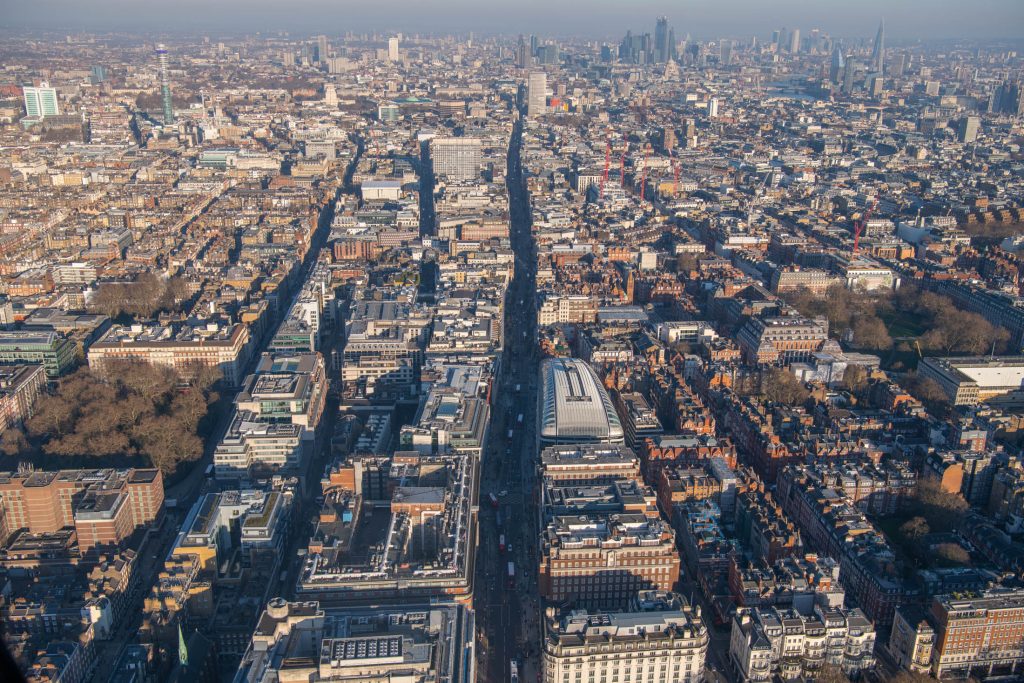
Oxford Street looking east from Marble Arch to Tottenham Court Road.
All metro mayors in England have the power to establish MDCs, subject to consultation with stakeholders such as the local authorities whose areas the MDC will operate in, MPs whose constituency is similarly covered and members of the public. For London this is slightly different, where the mayor has to consult with the London Assembly.
There are currently six MDCs in England, with two already in London; London Legacy Development Corporation (covering the former 2012 Olympics site in Stratford) and Old Oak & Park Royal Development Corporation. Planning powers are due to be returned to the four local authorities covered by the London Legacy Development Corporation later this year.
Under the Localism Act 2011, once an MDC has been designated by the mayor, the local government secretary is required to formally establish the corporation and its functions using secondary legislation.
What could all this mean? We asked Dave Hill.
It could be some time before the geographic scope and detail of powers sought by the Mayor are published and speculation therefore abounds.
We posed ten questions to journalist Dave Hill of On London, for his thoughts on what might and might not play out for Oxford Street and the surrounding area, including Marble Arch.
Read Dave’s responses below.

There’s been a lot of speculation and even a bit of early campaigning about where the boundary of the Mayor’s development area should be. It seems plain that it will encompass more than just the Oxford Street highway – why set up an MDC if all you want to do is replace Westminster Council as the highway authority? – but all interested parties are eager to know how much more.
They could be waiting for a while. I would be surprised if the Mayor himself has yet decided. The pedestrianisation announcement came out of the blue, and although I am sure people at City Hall have pondered various options there is a lot of thinking and consulting to be done before final decisions can be taken. This will be a very big and complicated project.
Such information as has been made public suggests the Mayor anticipates the MDC extending east of Oxford Street into Camden, though perhaps not very far (the nearest thing I’ve had to steer about this is that Camden Council, unlike Westminster Council, is not geatly alarmed by the proposal).
This would be logical, given that the eastern section of Oxford Street ends at its junction with Tottenham Court Road at St Giles Circus. Also logical would be the MDC embracing Marble Arch at the western end of Oxford Street, not least because the various traffic implications of pedestrianisation would have an impact there as well.
How much further might the Mayor want to go? How much wider than Oxford Street itself? How far up Tottenham Court? We’ve seen the boss of Soho Estates, a critic of Westminster, saying he’d welcome Soho being included. Once you’ve cast your net over Marble Arch, you’ve surely got to also at least consider revisiting the idea of transforming Park Lane from a wide motor highway into something more tranquil. The Mayfair Neighbourhood Forum are exploring feasibility on this point already.
All we know for certain at this point is that not much appears certain. There has been communication between GLA officers and their Westminster counterparts, but the process of settling on a precise geographical scope has barely begun.
The answer to the first question is surely “yes”. The answer to the second is less straightforward. There is, of course, already a detailed plan for rescuing Marble Arch from its roundabout isolation, one which enjoys the backing of the various interested parties. Presumably, that plan could be adapted to align with whatever the Mayor decides he wants to do. Any manifesto at this stage in the game might seek to emphasise the great potential of a revived Marble Arch and how integral it is to the spatial dynamics of Oxford Street, Park Lane and the West End as a whole. To marginalise it would be mad.
I would be amazed if the MDC did not become the local planning authority. The planning implications of large-scale pedestrianisation point firmly in that direction.
When I asked the Mayor’s press office about a request for licensing powers being declined, I was very swiftly told that this was incorrect. But perhaps that won’t be the last we hear of the matter. If the MDC is to assume responsibility for the economy of the area it covers, it would probably want to have significant formal controls over key aspects of the area’s economic activity in order to make the most of the hoped-for potential for growth.
Very big. I say that with confidence, despite not being a traffic management expert. It has long been a difficult issue and must be tackled effectively if any transformed Oxford Street is to avoid the perverse outcome of excluding a lot of people who go there at present.
I’m unfashionably sceptical about the efficacy of dedicated cycle routes in general. Insisting on drivers behaving considerately and abiding by the rules of the road – as cyclists should also do – is the best way to make cycling more appealing anywhere in London.
If Oxford Street and some of its surrounding district is to come under the control of an MDC in the strategic interest of London as a whole and, indeed, the entire nation, why would “hand back” ever happen?
Were I a very fed-up Westminster councillor just now I would – entirely properly – be going out of my way to assure local residents that any relationship or engagement I have with the MDC will be for the purpose of representing their views, whatever those views may be. Westminster’s leader has, I think, made it pretty clear in his list of concerns about the Mayor’s initiative that that is where he stands. If it seemed that more could be done to help residents’ voices be heard by not accepting a place on the board, I as a theoretical councillor would consider doing that.
The current boards of the Old Oak and Olympic Park MDCs, particularly the latter, contain personnel with expertise in community engagement and development, but no representatives of local residents’ groups as such. One difficulty with including such representation would be deciding which group or groups to choose and which to leave out. A better way for an MDC to recognise and act upon the legitimate worries – and, who knows, enthusiasms – of local people might be to simply make a sincere and serious effort to listen to them.
There is a strong regional and national economic argument for putting Oxford Street and its environs in the hands of the Mayor of London, but also a strong case against the area being turned into what one senior Westminster councillor has characterised as “party central” – a zone at the heart of the capital where a culture of consumption becomes all-conquering and antisocial behaviour runs rampant, diminishing more than enhancing long-standing aspects of the area’s appeal. Such an outcome would be a bad thing all round.
With thanks to Dave Hill for speculating with us, and providing such thoughtful answers to our questions.
